Mesh options, pattern placement and the plane the floor is laid on.
Mesh
Parameter
Description
Default
Cap bottom
Adds the tile undersides. Doubles the face count.
off
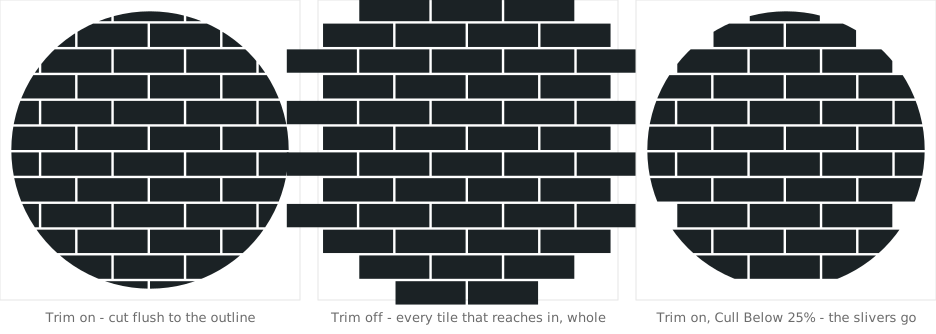
Trim tiles to outline
Cuts tiles at the outline. Off, every tile that reaches inside is laid whole.
on
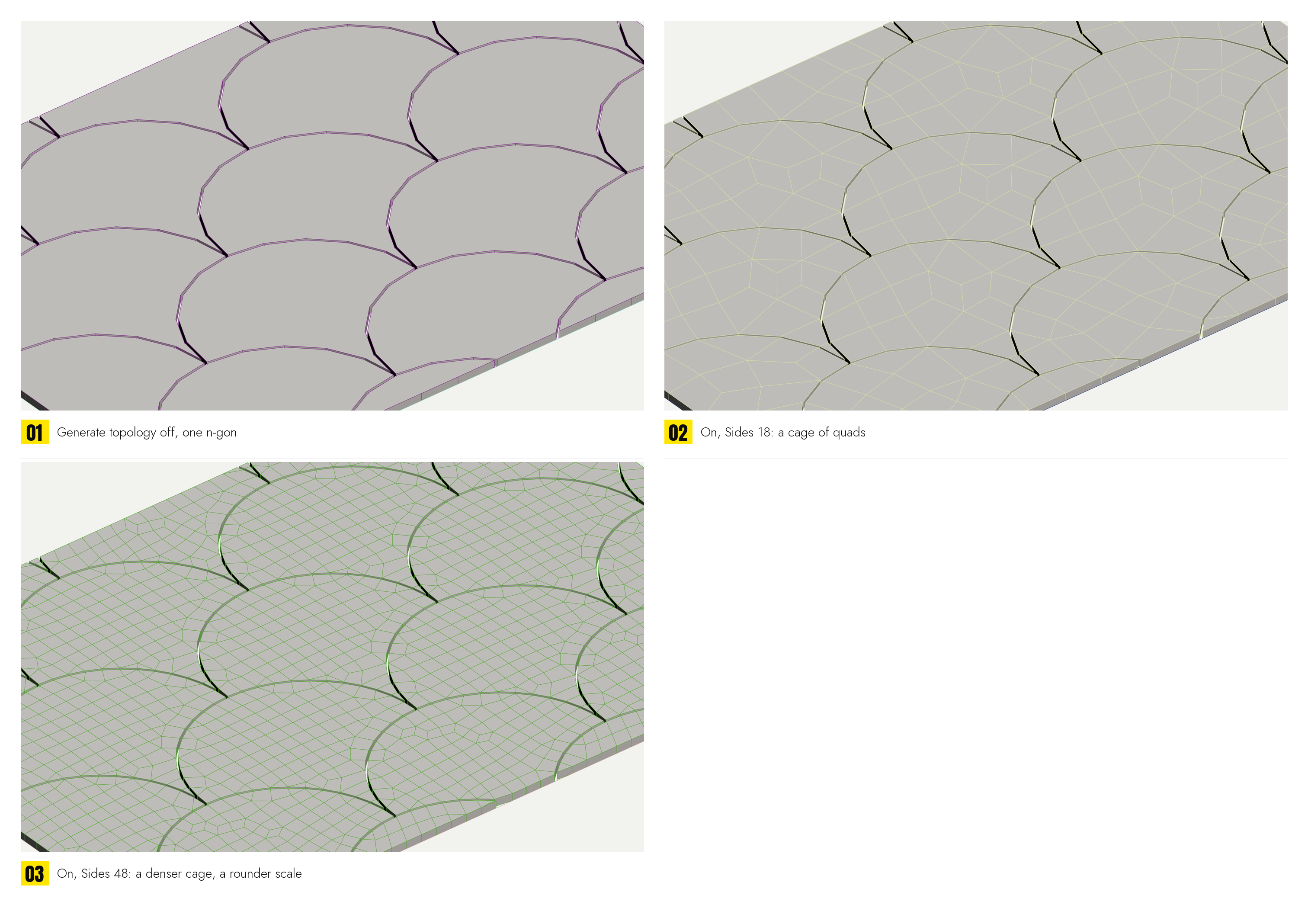
Generate topology
Meshes shaped tile faces as quads with inner vertices, for subdivision and displacement. Off, each face is a single polygon. The density follows Sides on patterns that have it.
on
Lift
Offset from the picked surface along its normal, in scene units.
0
Cull Below
Removes cut pieces smaller than this percentage of a whole tile.
0
A round floor: trimmed, untrimmed, and trimmed with the slivers culledTwo tiles cut by a curved wall close up, top face only: Generate topology off (one n-gon) and on (a cage of quads)
Placement
Parameter
Description
Default
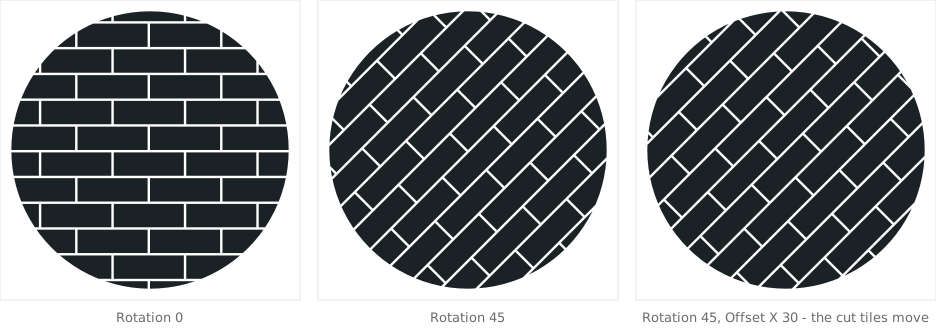
Rotation
Pattern rotation, in degrees.
0
Offset X / Y
Pattern offset along its own axes, in scene units. Also set by moving the pattern origin in the viewport.
0
Offset Z, Turn X / Y / Z
Third offset axis and origin rotation. Active only with Tile every surfacePro.
0
Scale
Scales every length of the row at once: tile sizes, joint, bevel, thickness and band widths, as a percentage.
100
Seed
Random seed for sizes, row offsets, board randomization and missing boards.
12345
Rotation 0, Rotation 45, and the same slid by Offset X: the cut tiles at the edge move, the pattern does not change
Plane
Parameter
Description
Default
Flip
Mirrors the floor through its plane. Use it when the picked shape faces the other way or for a ceiling.
off
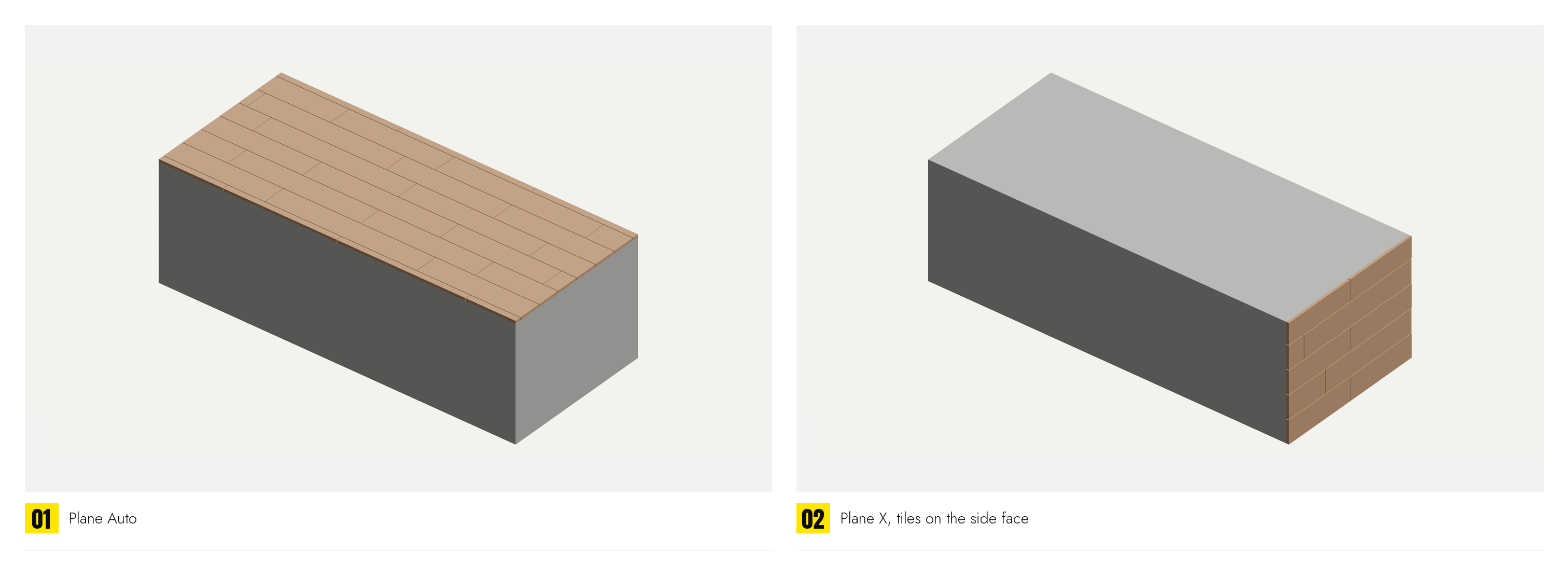
Plane › Auto / X / Y / Z
The object axis normal to the floor. Auto takes the plane with the largest area.
Auto
A box slab tiled with Plane Auto, then the same box with Plane X: the tiles on its side face