
Floor and Tiles · Documentation
Board Randomization
Random rotation, offset and tilt per board, and missing boards. Applies to every pattern; each row has its own settings.
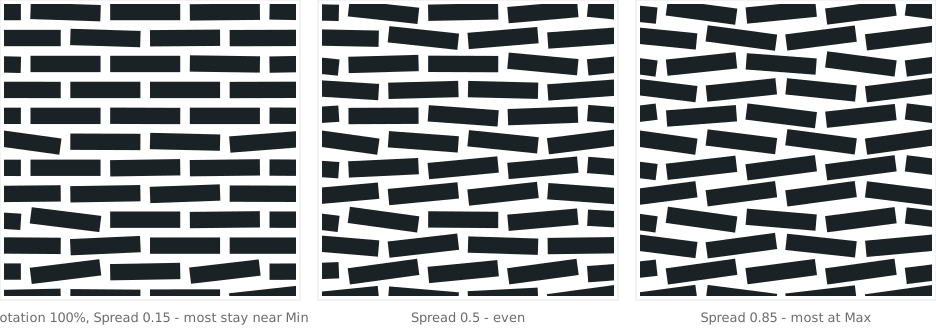
Rotation, Offset X, Offset Y and Tilt each have three values. Every board draws a value between Min and Max and a random direction. Spread sets the distribution: at 0.5 all values are equally likely, towards 0 most boards stay near Min, towards 1 most reach Max. Max at 0 turns the group off.
Boards move within the joint. With Grout at 0 there is no room and nothing changes until Max Overlap is raised.
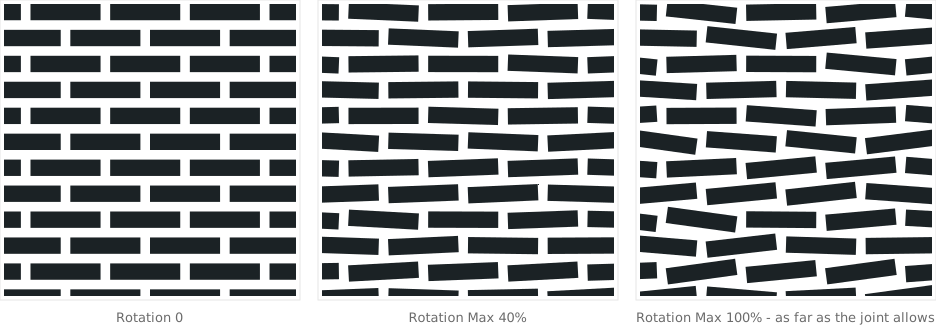
Rotation
| Parameter | Description | Default |
|---|---|---|
| Max / Min | Turn about the board centre, as a percentage of the largest turn that fits in the joint, up to 90°. | 0 |
| Spread | Distribution between Min and Max, 0 to 1. | 0.5 |
Offset
| Parameter | Description | Default |
|---|---|---|
| Offset X › Max / Min / Spread | Slide along the board's own length, in scene units. | 0 |
| Offset Y › Max / Min / Spread | Slide across the board. The padlock links it to Offset X. | locked |
| Max Overlap | How far a board may cross into its neighbour, in scene units. At 0 every move stops at the joint. | 0 |
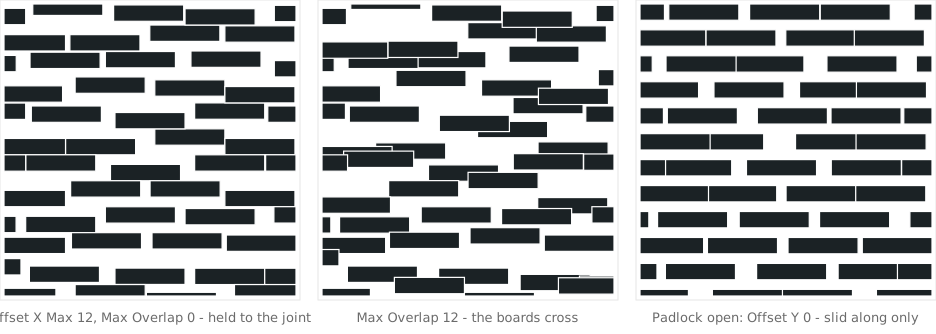
Rotation uses part of the joint, so a board that is turned has less room left for offset.
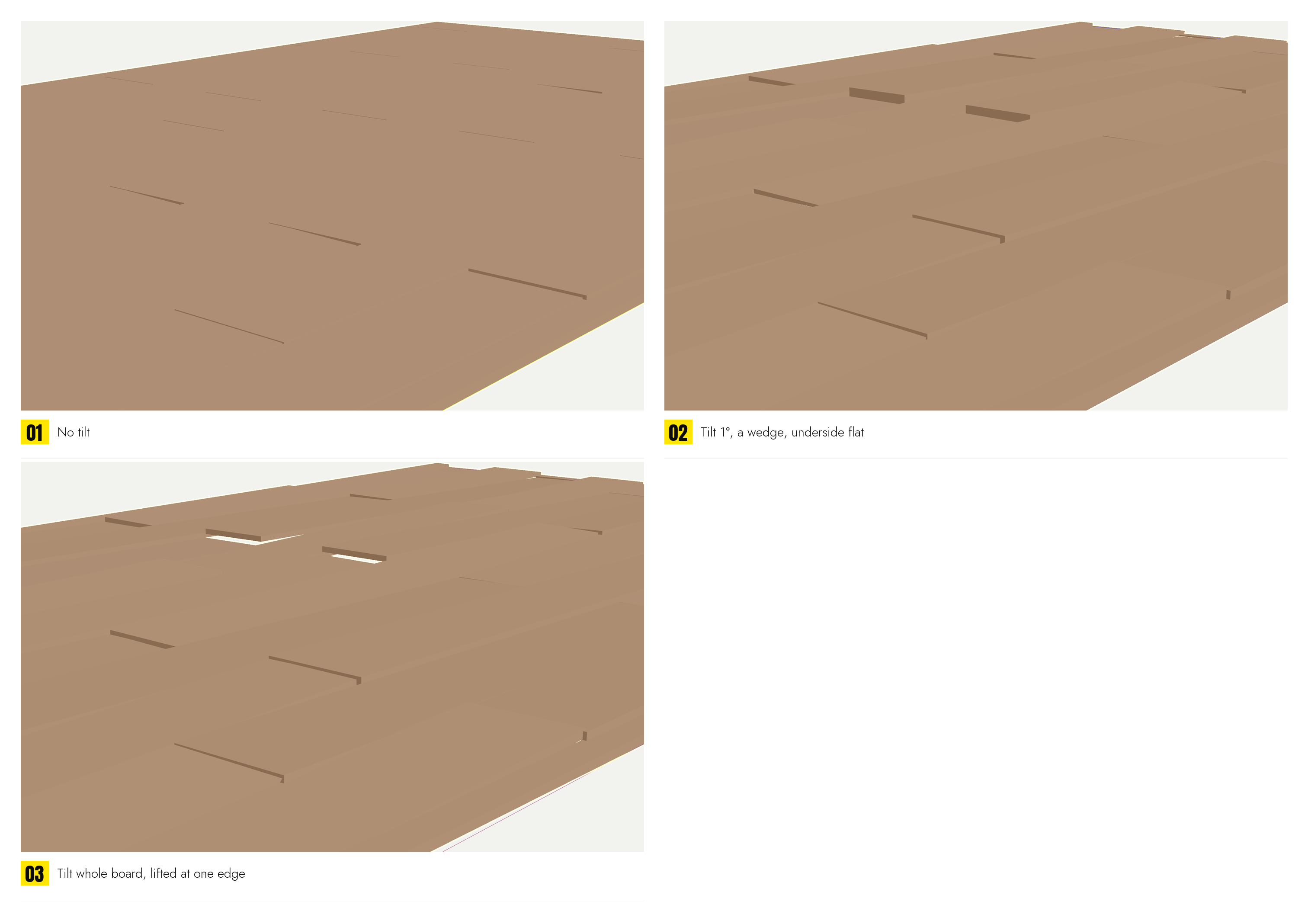
Tilt
| Parameter | Description | Default |
|---|---|---|
| Max / Min / Spread | Tilt in degrees, in a random direction. The top face leans and the underside stays flat. | 0 |
| Tilt whole board | Tilts the whole board instead, keeping its thickness; one edge lifts off the floor. | off |
Missing Boards
Removes boards from the floor. Neighbours are not moved into the gap.
| Parameter | Description | Default |
|---|---|---|
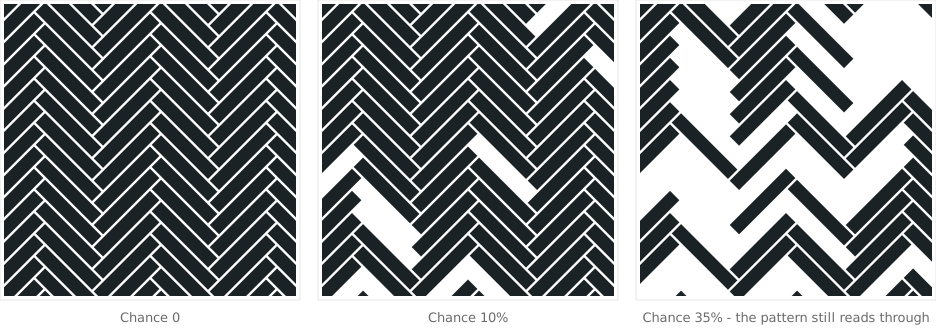
| Chance | Percentage of boards removed. | 0 |
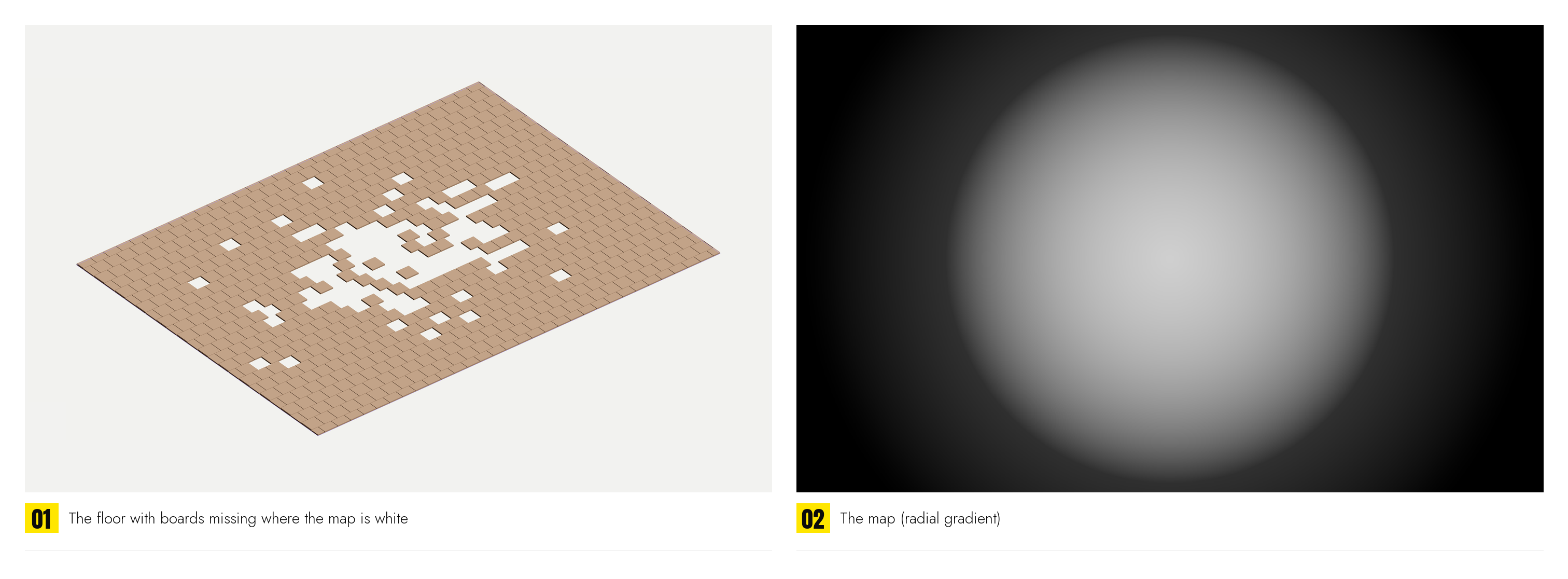
| Map | Greyscale map multiplied with Chance: black keeps the board, white removes it. With Chance at 100% the map alone decides. | none |
| Channel | Map channel of the picked object used to read the map. Without mapping on that channel the map is stretched over the floor. | 2 |
| Offset U / V | Map offset. | 0 |
| Tiling U / V | Map repeats across the floor. | 1 |
| Angle | Map rotation, in degrees. | 0 |
A board cut by a wall or a border is removed as a whole.
Seed: each board's random values depend on its position in the pattern and on Seed in General. Changing the outline or the sizes keeps them; changing Seed draws new ones.